Fool’s Errand: Richard Russo Returns to North Bath in Everybody’s Fool
Richard Russo
May 3, 2016
“Everybody’s Fool is much more than a sop to longtime fans, a stroll down memory lane, or a victory lap for Russo; it’s a captivating look into Sully’s long second act from a very different writer than the man who penned Nobody’s Fool a quarter-century ago. Everybody’s Fool teems with heartbreak, belly laughs, wild action and terror, reversals of fortune, empathy, and new insight into old friends.”
Richard Russo’s 2012 memoir Elsewhere marked the author’s first book-length foray into non-fiction, and his first attempt to describe his own experience growing up in Gloversville, New York, the dying upstate milltown he fictionalized so famously in his early work. Russo’s first three books—Mohawk (1986), The Risk Pool (1988), and Nobody’s Fool (1992)—portrayed the hard-used fictional towns of Mohawk (a near-dead ringer for Gloversville) and North Bath, and their blithely prosperous neighbor, Schuyler Springs.
But much more importantly, those three novels introduced readers to the remarkable cast of characters who inhabit those towns, their diner and dive-bar empathic camaraderie; their scuffling working lives; their marital tensions and fatherhood failures; and their salty, unrelenting, unsentimental, gut-busting humor. A regionally identified writer who has thoroughly transcended regional appeal, Russo has always maintained that his books are about people rather than locations, and that they depict a class rather than a place.
Perhaps the most beloved of all of Russo’s memorable characters is Donald “Sully” Sullivan, the feckless, aging, sharp-witted, perpetually laid off construction worker—the “Nobody’s Fool” of Russo’s third book’s title—who is at once the least and most dependable man in North Bath. Indelibly ushered into cinematic life by Paul Newman in Robert Benton’s 1994 Nobody’s Fool film (co-written by Russo), Sully’s knight-errant adventures (accompanied by his hapless but ever-faithful, Sancho Panza-like sidekick, Rub), could have kept readers engaged and entertained for a dozen sequels, but that’s not what Russo had in mind.
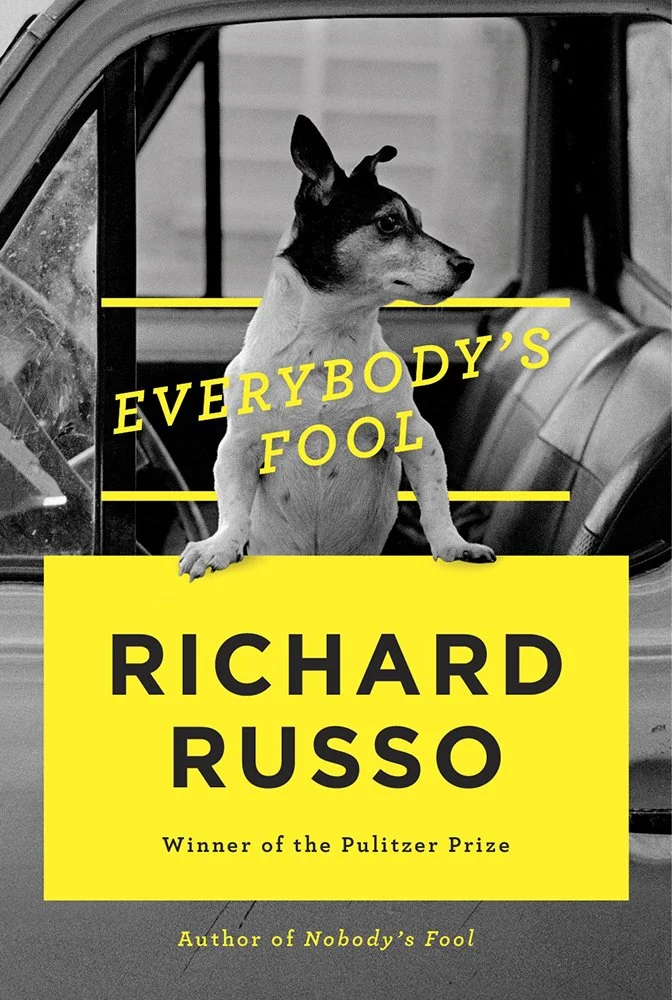
This week, at long last, and to many longtime Russo readers’ great delight, we have a Nobody’s Fool sequel: Everybody’s Fool, a new novel set in Sully’s North Bath hometown 10 years later. With it comes the welcome return of Sully, Rub, Sully’s sometime-girlfriend Ruth, his sometime-boss Carl Roebuck, Officer (now Chief) Raymer, and other habitués of Hattie’s Diner and the White Horse Tavern. But Everybody’s Fool is much more than a sop to longtime fans, a stroll down memory lane, or a victory lap for Russo; it’s a captivating look into Sully’s long second act from a very different writer than the man who penned Nobody’s Fool a quarter-century ago. Everybody’s Fool teems with heartbreak, belly laughs, wild action and terror, reversals of fortune, empathy, and new insight into old friends.
Why bring these characters back for another go-round? One answer might come from Carl Roebuck and Sully atop their barstools at the White Horse:
Carl shrugged… “Do you believe in reincarnation?”
|“You mean like we die and then we have to do this fucking thing all over again?”
“Yeah, like that.”
“Jesus, I hope not.”
“I don’t know,” Carl said. “Second time around we might be smarter.”
“We might be dumber, too.”
But why return to North Bath? Why now? Here’s what Richard Russo had to say about it.
Nathans-Kelly: It’s been a long time since you’ve returned to the first fictional towns you created—Mohawk, North Bath, and Schuyler Springs. There aren’t many instances where authors have revisited a place or a set of characters after so much time away. I’m not complaining, of course, and neither will most of your readers, but why North Bath, why Sully, and why now?
Russo: Well, first of all, I never intended to do this until I actually started doing it. It was the farthest thing from my mind. I guess the most important of these books that take up with a character again over a period of time is John Updike’s Rabbit books. I love those books, but I never had any real desire to revisit any of my characters in quite that way. You could tell that Updike was hunting big game there: He was filtering America through the eyes of Rabbit at various points in Rabbit’s life. It was Rabbit but it was also America. They are very ambitious books, and he brought them out in kind of a regular way.
As much as I admired those books, and as much as I admired Larry McMurtry for going back to The Last Picture Show and picking Duane out of that group of fictional characters and revisiting him every decade or so with a new book, I really have no desire to do anything like that. When you finish a book, you’ve tied up the conflict that drove the book forward. At the end of Nobody’s Fool, Sully’s conflict had been resolved, and there wasn’t anything eating at me about the way I’d resolved it, or a particular reason to return to North Bath.
My fans seem to think otherwise. My agent has been asking me for years to write another Sully novel. After Robert Benton's much-beloved movie [Nobody’s Fool, 1994] came out, that gave the book another jolt. Paul Newman of course, created that character. I don't even own Sully anymore. I kind of co-own Sully with him.
Nathans-Kelly: If only it were so easy to bring back Paul Newman.
Russo: I know, and I would have in a heartbeat. Then there was also Howard Frank Mosher, who this book is dedicated to. We’re kind of aesthetic partners and we enjoy many of the same jokes. Every time I’d see Howard since Nobody’s Fool came out, he would say, “What’s up with Sully and Rub?” as if they were real and I would know. This went on for about 20 years.
At one point several years ago, I had heard a story somewhere of a man who needed to prune a limb from a tree and didn’t have anyone to help him. So he grabbed the chainsaw, tied the chainsaw to a piece of rope, dragged the chainsaw up into the tree, sat on the limb he wanted to saw off, and sawed the limb off. Then he realized that when he was sitting there with his back to the tree, he had no way to get down. He could lower the saw, but then he had nothing to hold on to with the tree limb down there.
When I heard about that, it was just such an inspired failure of imagination that I thought of Rub, and the next time I saw Howard I said, you know what I think I might have something here for you.
Nathans-Kelly: So Rub’s been stuck up in that tree for ten years.
Russo: That’s right, waiting for me to come rescue him. This was probably about ten years ago, and this story stuck in my mind. Then I heard another story of lunacy about a local cop who discovered a garage door remote in his wife’s car. It didn’t open their garage, but obviously it opened someone’s, and he immediately jumped to the conclusion, as Raymer does in Everybody’s Fool, that his wife must be having an affair, and actually runs around town trying to find out whose garage door the garage door opener would open.
So with those two things—imagining Rob up in a tree sitting there waiting for me to come get him down, and Officer Raymer trying to figure out who is having an affair with his wife—it just felt like a North Bath story wanting to be told. That’s the genesis of the book. I started it about six years ago.
Nathans-Kelly: Did you start this book before you finished [your 2012 memoir] Elsewhere.
Russo: Actually, I interrupted this book to write Elsewhere. I interrupted a book I was having an enormous amount of fun writing to write a book that I knew was going to be no fun at all, although that turned out to be not quite true.
It was fun to start, and when I came back to it after taking a couple of years to write Elsewhere, it was even more fun from that point on. It was great to be back with Sully and Rob and Miss Beryl, who’s been dead ten years before this book began but is still very much present. It was good to be back with her and seeing Raymer, such a minor character, develop into a dramatic force in his own right.
Nathans-Kelly: Unlike Nobody’s Fool, Everybody’s Fool seems to be almost as much Raymer’s book as Sully’s book. He’s the title character.
Russo: Yes, although he has a lot of competition for the role of Everybody’s Fool. There isn’t anybody in this book who isn’t some part idiot, some part fool. It’s another way of saying that they all come from me.
Nathans-Kelly: When you go back to these characters ten years later in their lives, 20 years in yours, how hard is it to get back into the place where your head was when you created these characters in the first place? Does it make it easier that they live in a town where their lives aren’t likely to change all that much?
Russo: Well, that certainly helps. That is the thing about these towns that I write about: Change doesn’t happen as quickly there as it does most other places. Part of the reason that this is a North Bath story, I suppose, is that in the foothills of the Adirondacks, technological change—in this case, the advent of cell phones and computers—was slow to arrive. It would have been difficult to tell that story in California or almost any place else.
All I did before I started writing was just re-read Nobody’s Fool and watch the movie. I think what was probably more difficult than getting back into the world of North Bath and Schuyler Springs, and to imagine what kind of changes would have taken place there, was to consider all the changes that had taken place in me. I’m 20 years beyond those events detailed in the earlier book. My children were children when I wrote that book; now my daughters are in their thirties. I’m a grandfather now. There’s a lot of water under my particular bridge. Going back to that world, I wanted to know what was going on in the characters’ lives, but I couldn't pretend to be the younger writer that I was when I wrote that book.
Inevitably, characters like Sully and Miss Beryl in this book are going to be a little bit different because the person writing about this and remembering them and feeling them now, is seeing them through slightly different eyes and through a different set of experiences. When we see Sully going off to war, and Miss Beryl being disappointed at him doing so, and wondering if he is doing so for the wrong reasons—you wouldn’t see that in the earlier book. I wouldn’t have been capable of writing that then.
Nathans-Kelly: Miss Beryl plays a big role in this book, even though she’s dead; things she said to Sully and Raymer when they were younger frame their whole journeys in Everybody’s Fool. We hear the voices of the dead in characters’ heads in a lot of your books, whether it is Clive, Sr. or Big Jim Sullivan in Nobody’s Fool or Jack Griffin’s mother in That Old Cape Magic. It kind of reminds me a little bit of Faulkner’s “The past isn’t dead—it isn’t even past.” The dead aren’t really dead in your books.
Russo: Structurally, the book begins with Sully looking at Miss Beryl’s picture in the paper and learning that the middle school is going to be re-dedicated to her, and from Raymer’s point of view as he moves closer and closer to giving the address at the middle school to honor Miss Beryl. She is kind of a presiding spirit. She is allowed to change a little bit even in terms of her picture in the newspaper, because according to how Sully folds the newspaper, her expression seems to change. The way she is looking at him seems to change according to the angle of the newspaper and whether it is folded or not. It is fun to watch her have her say, and help these men to grow and find their way as the dead often do.
This book was full of heartaches. Miss Beryl, of course, is gone, because she was in her eighties then and suffering strokes, so she couldn't be alive ten years later, or if she was alive she would be in such a state that she wouldn’t be of much use as a fictional character. And of course that fictional world parallels our world in a very real way, because since Robert Benton made his wonderful movie of Nobody’s Fool, we lost Jessica Tandy [who played Miss Beryl], Paul Newman [who played Sully], and Philip Seymour Hoffman [who played Raymer].
I was halfway through this book when Philip died, and how could I not be thinking about him? He had a minor role in Nobody’s Fool, but it was his first significant role in a major motion picture, and what fun that would have been for him to come back at a time when he was one of the most revered actors we had, to bring fresh life to one of his first significant roles. What a gas that would have been for him, and of course for me too to see that happen. So there was a lot of heartbreak in the writing of this. It was great fun, but it was melancholy fun.
Nathans-Kelly: I also wanted to ask you about the Curt Wright episode that happens at the university in Schuyler. That seems like this killer short story unto itself, or maybe the start of a whole other academic novel about a grifting serial homewrecker who specializes in political science departments. Besides bringing Mayor Gus Moynihan and his wife Alice to Bath, what is that doing in this book?
Russo: You’re not the first to ask that question. My agent actually wanted to excerpt that and submit it to the New Yorker, and use it as an excerpt from this book, or possibly cut it out, and I thought long and hard about that. As much as it seems to stand alone there in this book, and it feels a little bit like an appendage, it didn’t feel like a completely standalone piece. It works as an episode, but it doesn't really seem to me to have the shape of a story.
When I started writing it, I think my purpose in the book was to have some explanation for what happened to Alice, why she goes around town with her princess phone pretending it is a cell phone. This is a question you ask of every fictional character is: Why is this person the way they are? What is the back story? In this case, the back story turned out to be much longer and much more disturbing than I ever intended it to be.
The more I got into Curt Wright’s character, the more fascinated I became by him. He is as close to Hawthornian pure evil as any character I’ve ever encountered because it is so intellectual for him. He’s basically bored. The only way for him to spruce up his life is to ruin other people’s. He’s a very Roger Chillingsworth sort of guy.
Nathans-Kelly: A couple of weeks ago when Merle Haggard died, I read an article by a writer who was remembering the first time he interviewed Haggard. Riding on the tour bus, he got Haggard talking about growing up so poor that every time he heard a train pass by he thought, “I’ve got to get on that train, wherever it’s going, and just get the hell out of here.” The interviewer says, “I grew up middle class in suburban New Jersey, but I know just how you felt because I couldn't wait to get out of there either.” Haggard explodes and says, “There is no way anybody that didn’t grow up exactly the way I did could have any idea what I’m talking about.” The writer looks up and sees that a roadie is now holding him at gunpoint, and mucks out of it by saying, “If your stories spoke only to people who grew up exactly like you, you wouldn’t be Merle Haggard.” Going back to the very beginnings of your career with Mohawk and The Risk Pool, and Nobody’s Fool, and returning to Bath now with Everybody’s Fool, when you set out to write about an area that is very distinctive, and very specific to where you came from, are you consciously thinking about how you can take this very specific experience or place and make it universal, or are you just trying to tell the story you know as best you can?
Russo: I’m somewhere in between the two. I have great faith in specificity, and it has only grown stronger over the years of my career—a longer career than I imagined when I started. But the more specific things become, the more universal they become if you are working at a very high level. I don't mean to put myself and Faulkner in the same category, but that is the thing about Faulkner: He is at once our most regional writer, and our most universal writer. The two things often go hand in hand. When writers are regional writers and somehow they don’t have a readership beyond their region, there’s almost always something else going on—there is something that is preventing them from being read more universally.
I’ve always felt that it was my job to tell the story that I knew. Part of it, for me, was this discovery of who and what I was. These are the people that I love; this is the kind of work that they do. I understand them, and I will write about them as truly as I can. Over the years of being on the road with these books, I’ve constantly had people coming up to me and saying, “The town I grew up in was just like yours. My father was just like yours.” So I say, “Where are you from?” and they’ll say, “Jackson, Mississippi” or “a suburb of Portland, Oregon.” Often I’ve never been to the places they mention, but clearly, despite the fact that I’ve been very specific about upstate New York mill towns, something rings true to people in Jackson, Mississippi. I’m mystified as to what it is.
Back when I was teaching, I always tried to explain that to students [about their writing]. I’d say, “Look at how vague all of this is,” and they would say, “I want my readers to supply the details.”
I would say, “That’s not their job; that’s your job.” They would tell me they didn’t want to get down to the level of sights and smells and sounds, or become tactile; “I’ll let the reader fill that in with their experience.” But being vague doesn’t get you anywhere. It’s not that you’ve excluded people; you just haven’t included anybody.
In my books, I’m absolutely certain that if I had been less specific, more general, more vague, in a way that would seem to be more inclusive to everyone, it wouldn’t be nearly as universal. Don’t ask me to explain why that would be true, but it is.
This interview was originally conducted for Paste.